
Pend Oreille County Court Record Requests
Start with Washington Case Search or Odyssey to find the case. Write down the court, case number, event date, and document title before you go further. Then think about what product you actually need from the docket: a plain copy, an electronic copy, a certified copy, or a recording.
- Identify the court and exact case number.
- Note the dated event and document title.
- Send Superior requests to the County Clerk and District or municipal-contract requests to District Court.
- Select paper, email, certified copy, CD, or transcript route.
- Pay the posted fee and verify the delivered number and date.
For Superior files, call the County Clerk at 509-447-2435. For limited-jurisdiction files, call District Court at 509-447-4110 or 800-359-1506. Besides searching online, you can request records at the counter, by mail, fax, email, or through a form.
Docket, Document, Certified Copy
People often mix up three different products. The docket, or register of actions, is a chronological index of filings, settings, orders, and decisions. Behind each event sits a filed document. It may be the complaint, petition, answer, motion, order, judgment, exhibit, or notice itself. A certified copy is different again, because the clerk produces and authenticates it.
- Docket
- A searchable event list, not the complete file.
- Filed document
- The actual paper or image received by the court.
- Certified copy
- A clerk-authenticated copy with a certification fee.
- Transcript
- A written record obtained through the court reporter, not inferred from docket text.
A printout from an online screen is not certification. Anonymous Odyssey access gives public case information, but it does not hand over document images automatically.
Kinds of Court Records
Which office holds the record depends on the court. The County Clerk keeps Superior felony cases, major civil matters, domestic and probate files, guardianships, judgments, protection orders, and juvenile-related records. All are subject to access rules. District Court holds misdemeanors and gross misdemeanors, felony first appearances, infractions, limited civil cases, small claims, protection orders, and name changes. It also keeps records for five municipal courts under contract.
- Case dockets and registers of actions
- Complaints, petitions, answers, motions, and notices
- Orders, judgments, dispositions, and public exhibits
- Hearing recordings when maintained
- Certified copies for uses requiring clerk authentication
Court records in Pend Oreille County stay with the court named on the case, not with where a person lives. A Newport, Cusick, Ione, Metaline, or Metaline Falls municipal matter runs through District Court.
Pend Oreille Record Custodians
The Pend Oreille County Clerk serves as ex officio clerk of Superior Court and its official record keeper. Send Superior requests to 229 S Garden, PO Box 5020, Newport. District Court requests go to PO Box 5030, by fax at 509-447-5724, or by email at districtcourt@pendoreille.org.
| Record | Custodian | Route |
|---|---|---|
| Superior case | County Clerk | Odyssey or state search, then clerk |
| District case | District Court | State search, counter, or form |
| Municipal case | District Court contract service | Select city court, then District Court |
| Live transcript | Court reporter | Ask court for the assigned reporter |
Court Records: What They Contain
A public Pend Oreille court record can show the case number, court, filing date, case type, and caption. It may also list the parties and their roles, the judicial officer, status, cause or charge, events, hearings, dispositions, and links to authorized documents. What you actually see depends on case type and access level.
| Case information | Number, court, type, file date, caption, and status. |
|---|---|
| Party | Public names, roles, and attorneys where shown. |
| Events | Chronological filings and order entries. |
| Hearings | Date, time, type, location, and officer when public. |
| Disposition | Outcome entry that should be read with the signed order. |
The County Clerk’s official records page provides document-search links:
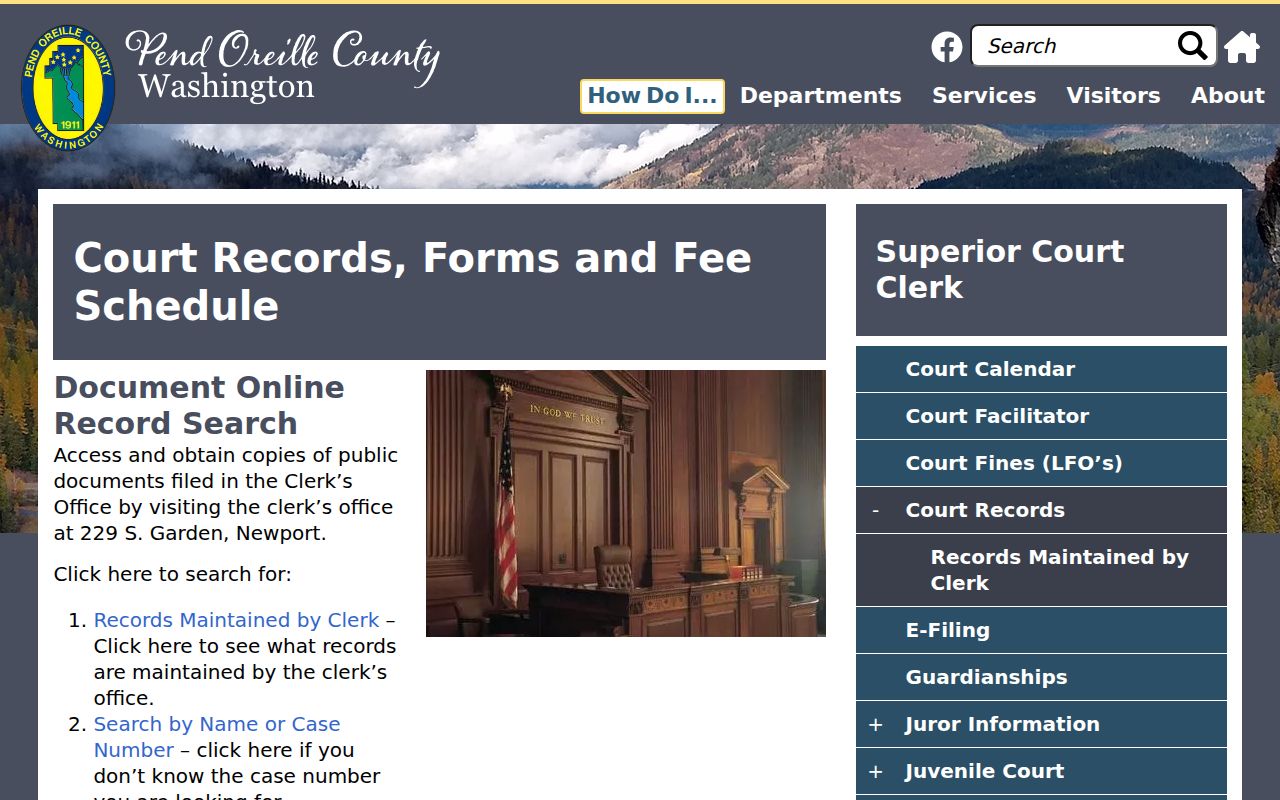
The image shows the local bridge from case lookup to a clerk document request.
Pend Oreille Copy Form Details
The District Copy/Records Request form asks for your contact details, the defendant name, the case number, hearing dates, and whether you want filed-document copies or a CD. Payment is due when you submit it. The form states records are available within two weeks after payment. A broader information form asks about intended use and dissemination, which suits reports or data projects better than one known document. Send it by mail, delivery, fax, or email. Describe the item precisely. "Order entered on the listed date" works far better than "all records." GR 31 governs a case-record request. Operational counts and management material follow the administrative route under GR 31.1.
Copy Fees and Certification
Plain and certified copies carry different prices, and certification adds only the clerk's authentication, not extra case content.
| Item | Published fee |
|---|---|
| Paper copy | $0.50 per page; District minimum $1 |
| Email/electronic copy | $0.25 per page |
| Certified copy | $5 first page, $1 each additional page |
| District CD | $10 plus $3.50 mailing |
For mailed Superior copies, the Clerk adds postage, so state your certification need at the start. The District payment window closes at 4:15 p.m. Transcript rates vary by court reporter, since the county pages publish no universal amount.
Microfiche After Online Coverage
Check the County Clerk's records page before assuming a file is off limits. It says Superior documents filed since January 1, 1996 exist as computer images, viewable online or at the clerk's office. Older or non-online cases may still be on microfiche or the Clerk's computer.
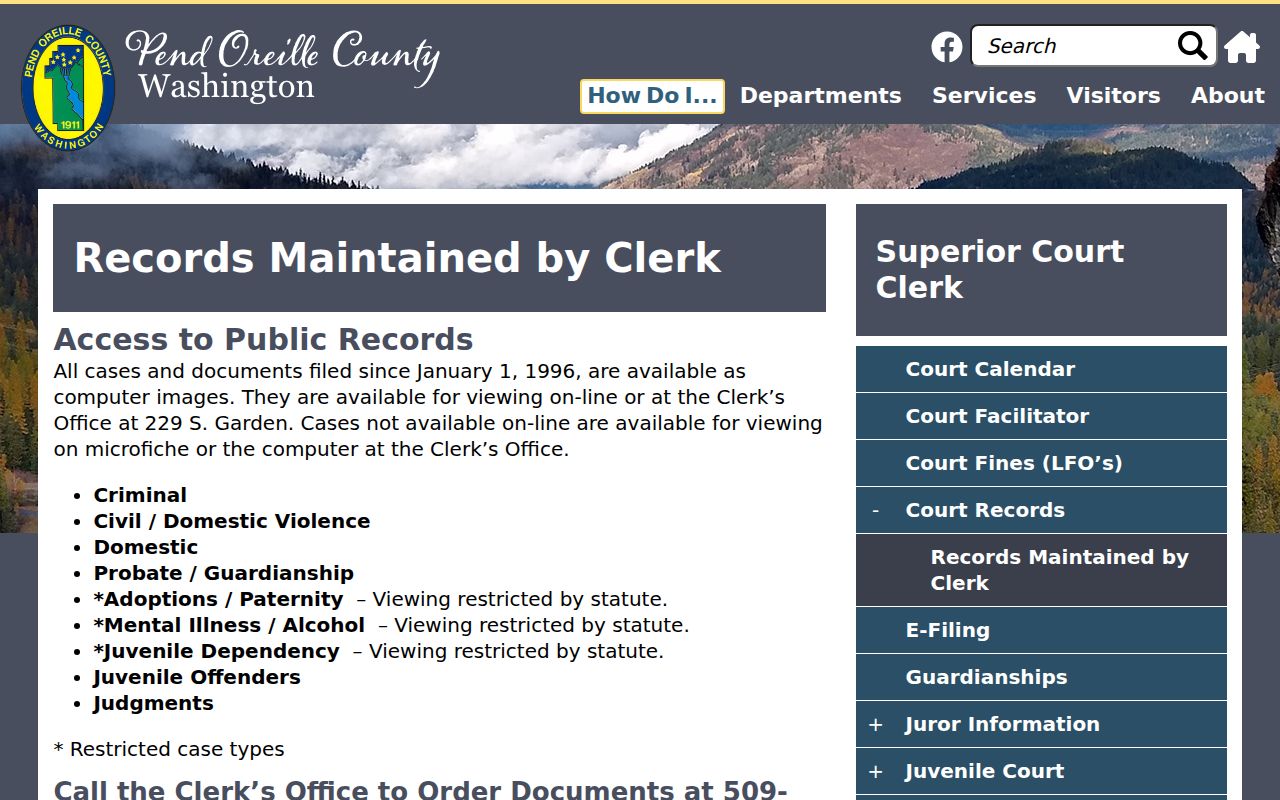
The coverage notice explains why a missing image does not prove a document never existed. When you ask for an archive search, give the year, case type, party, and number.
Box Filing Is Not Access
Pend Oreille runs Box upload workflows for Superior and District e-filing, plus OnBase for new protection-order packets. Those systems receive filings. They are not public reading portals. Superior filing requires PDF format, portrait pages, no embedded video, and keeping originals for 60 days under GR 17. District lists its own eligible and excluded filing types. Never create a Box account to hunt for a public order. Find the docket event first, then request the document from the clerk. JIS-Link is likewise display-only and does not deliver case documents. The same distinction matters for protection orders. A new packet can go through OnBase without an e-submission charge, but public access to the resulting case still follows court-record rules and any protective limits. A submission receipt proves delivery to the filing channel. That does not make the packet a public download. It also does not replace a filed-stamped copy from the court. District e-filing accepts new cases after fee payment and assignment of a number, pleadings in open cases, civil orders, answers to writs, and some non-certified writs. The county excludes appellate certified records. It also bars hearing or trial papers presented in court, sealed foreign judgments, certain fee-waiver papers, bail bonds, and trial exhibits. These limits are exactly why filing and record retrieval stay separate tasks.
Access Rules for Court Records
Washington GR 31 presumes court records are open and allows free viewing at the courthouse unless law, rule, order, or case law restricts the material. GR 15 governs sealing and redaction. GR 22 protects parts of family and guardianship records.
Restricted records: Juvenile, adoption, paternity, mental-health, sealed, protected family, and some exhibit material may be absent or limited. An index clue is not permission to view a file.
Missing a record does not mean it is sealed. Check the basics first. Look at the court level, the name spelling, and the date you used. Also try any older case number, image coverage, and possible restrictions. Juvenile offender information never appears on the statewide public website. Ask for access instructions instead of demanding protected content.
Two kinds of records take two different forms here. GR 31 governs the judicial file itself. GR 31.1 covers records about court administration, such as operational reports or management material. The local form allows a five-working-day response period in ordinary circumstances. That timeline is not a shortcut around a seal or a protected case category. A District Request for Information form can seek broader data. It asks for intended use and dissemination details. The case copy form is narrower. It fits a known defendant, number, hearing, document, or recording.
In-person inspection still matters. Ask the County Clerk about its public computer or microfiche for Superior records. Ask District Court about the limited-jurisdiction file. Phone and mail requests work best when you name the precise court and event. A portal's missing document link is never the whole official file. Nor is a JIS-Link display or an anonymous Odyssey result.